
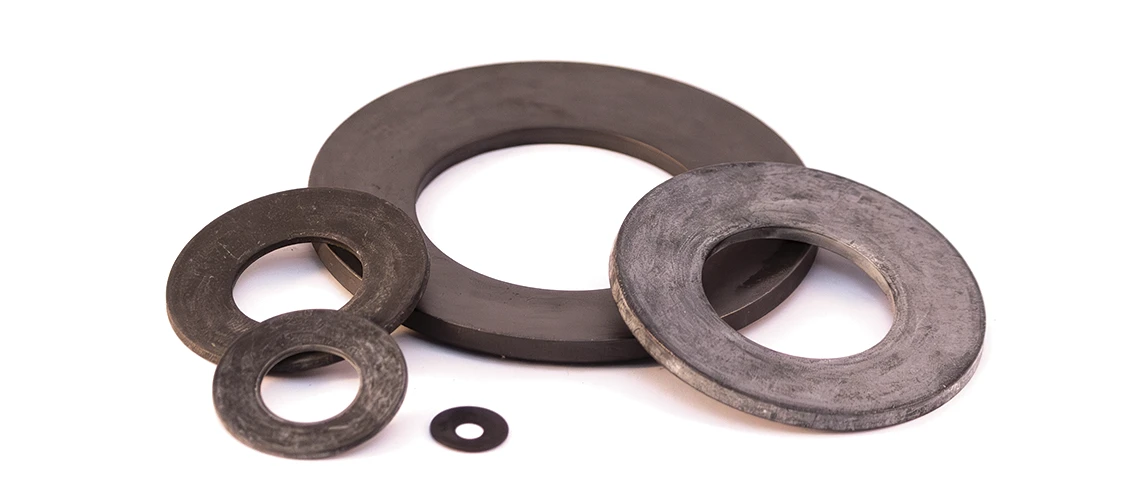
Disc Springs: High Load Performance in Compact Spaces
Disc springs, also known as Belleville washers, are conical (saucer-shaped) spring washers designed to generate high loads within a very small or restricted space. They are widely used in applications requiring vibration resistance, load compensation, and precise preload control.
ASI Springs stock an extensive range of disc springs manufactured to DIN 2093 from high-strength spring steel (51CrV4). Sizes are available from as small as 8.0 mm outer diameter and 3.2 mm inner diameter, up to large industrial sizes exceeding 600 mm outer diameter.
In our product range, we supply both disc springs and Bellville washers. While these terms are often used interchangeably within the industry, we distinguish disc springs as machined components and Bellville washers as pressed components. This distinction helps ensure clarity when matching samples and specifying performance requirements.
Key Dimensions and Definitions
Accurate measurement of disc spring dimensions is essential to ensure supplied parts match the sample and perform as expected.
- Outer Diameter (OD): The overall outside diameter of the disc spring.
- Inner Diameter (ID): The diameter of the central hole.
- Thickness (t): The material thickness of the disc spring. This has a major influence on load capacity.
- Free Height (h₀): The height of the disc spring in its unloaded (free) condition.
- Working Height (h): The height of the disc spring under load.
- Deflection (s): The amount the disc spring compresses under load.
- Load (F): The force generated at a given deflection.

Figure 1: Key dimensions of a disc spring
Stacking Disc Springs
One of the key advantages of disc springs is their ability to be stacked in different arrangements to achieve specific load and deflection characteristics. Stacking allows a wide range of performance options using the same spring size.
Stacks in Series (Increased Deflection)
When disc springs are stacked alternately (facing opposite directions), they are considered to be stacked in series. This arrangement increases the total deflection while maintaining approximately the same load as a single disc spring.
- Total Height: Increases with each additional disc.
- Deflection: Increases proportionally with the number of discs.
- Load: Remains approximately the same as one disc spring.
- Typical Use: Applications requiring greater travel or flexibility.
Stacks in Parallel (Increased Load)
When disc springs are stacked in the same orientation (nested together), they are stacked in parallel. This arrangement significantly increases load capacity while maintaining the same deflection as a single disc spring.
- Total Height: Remains similar to a single disc spring.
- Deflection: Same as one disc spring.
- Load: Increases proportionally with the number of discs.
- Typical Use: High-load applications with limited available space.
Combined stacking arrangements (series and parallel together) allow designers to fine-tune both load and deflection to meet exact application requirements.

Figure 2: Stacking in parrellal and series a disc spring
Real-World Applications
Disc springs are commonly used in bolted joints, vibration damping systems, valves, bearings, heavy machinery, and preload applications where space is limited but high force is required.
Design Considerations
When selecting disc springs, consider load requirements, available installation space, material properties, and stacking configuration. Small changes in thickness or stacking arrangement can produce large changes in load and deflection.
Why Choose Our Disc Springs?
ASI Springs stock and supply high-quality disc springs manufactured to DIN standards. We assist customers in selecting the correct size and stacking configuration to ensure supplied springs match sample performance and application requirements.
Request Disc Spring Assistance
Our experts are ready to help you select the correct disc spring or stacking configuration.