
"The Force Behind Every Motion"
.
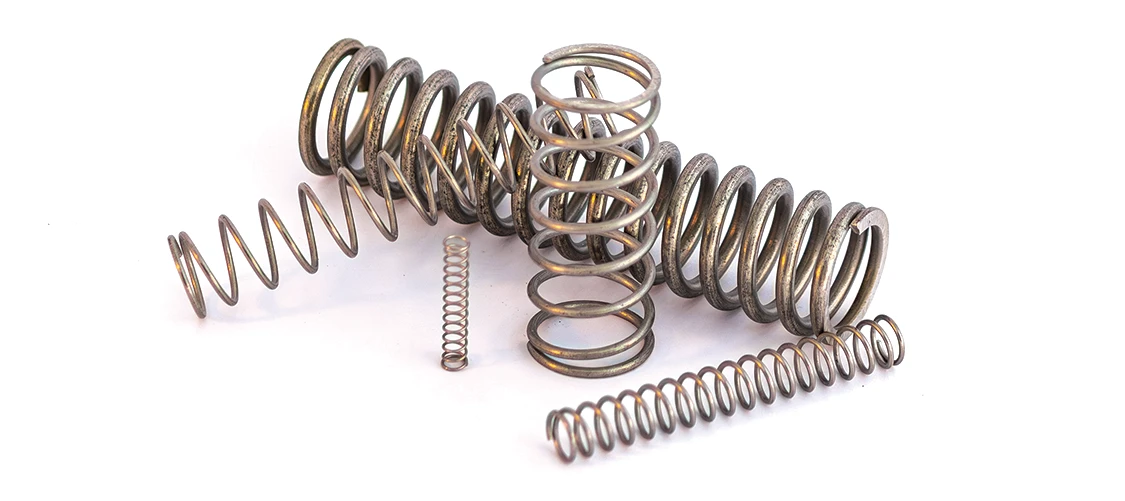
Compression Springs: Reliable Force, Perfect Performance
Compression springs are mechanical components that store energy when compressed and release it to perform work. They are essential in devices ranging from pens and electronics to automotive suspensions and industrial machinery.
Key Dimensions and Definitions
Understanding the dimensions of a compression spring is critical for proper design and performance:
- Wire Diameter (d): The thickness of the spring wire. A thicker wire increases strength and stiffness.
- Outer Diameter (OD) / Inner Diameter (ID): OD is the total diameter of the spring from outside edge to outside edge. ID is the distance from inside edge to inside edge. These determine the space the spring fits into.
- Free Length (Lf): The length of the spring when it is not under any load or compression.
- Solid Length (Ls): The total length of the spring when it is fully compressed, with all coils touching each other.
- Number of Coils: Total number of turns in the spring. This includes active coils (that compress) and inactive coils (often used at the ends for stability).
- Pitch (P): The distance between the wire centers of adjacent coils. Larger pitch reduces spring stiffness.
- Spring Rate (k): The amount of force required to compress the spring by a unit distance, typically expressed in N/mm or lb/in.
- Load P: The load applied at Length 1 and considered approximately the maximum safe load the spring can carry without permanent deformation.
- Length 1: The spring length when under Load P, considered the maximum safe length for reliable operation.

Figure 1: Key dimensions of a compression spring
How to Calculate Total Coils
Total coils can be calculated by counting all the wire turns along the spring. Active coils are used in load calculations, while end coils may be inactive depending on the spring design. Proper counting of coils ensures that the springs supplied match the sample specifications.

Figure 2: How to count coils in a compression spring
Spring End Types and Manufacturing Conditions
Compression springs can be manufactured with different end configurations and post-production processes. These options affect how the spring sits, performs under load, and its overall durability.
Open Ends
Open-end springs have coils that continue in the natural helix of the spring without modification. The final coil does not touch the adjacent coil, leaving the end slightly angled.
- Simplest and most economical end style.
- Ends are not flat, so load distribution may be uneven.
- Common in applications where precise seating is not required.
Closed Ends
Closed-end springs (sometimes called squared ends) have the final coil bent so it touches the adjacent coil. This creates a more stable seating surface compared with open ends.
- Improves stability and alignment.
- Better load distribution than open ends.
- Common in many general mechanical applications.
Closed and Ground Ends
Closed and ground springs are first squared so the end coil touches the adjacent coil, and then the ends are ground flat. Grinding produces a very even load-bearing surface.
- Provides the best stability and alignment.
- Ensures the spring stands perpendicular to the mounting surface.
- Common in precision machinery, automotive, and high-load applications.
Scragging (Presetting)
Scragging is a controlled process where the spring is compressed to solid height or beyond its intended working deflection during manufacturing. This intentionally relieves internal stresses and stabilizes the spring material.
- Reduces the risk of permanent set during normal operation.
- Allows the spring to operate safely at a higher percentage of material stress.
- Improves long-term dimensional stability.
Shot Peening
Shot peening is a surface treatment where small spherical media (steel or ceramic shot) are blasted against the spring surface at high velocity. This creates compressive residual stresses in the outer layer of the material.
- Significantly improves fatigue life.
- Helps prevent crack initiation and propagation.
- Common in high-cycle or dynamic load applications such as automotive and aerospace springs.
Doubling Springs: Series vs Parallel
Sometimes multiple springs are combined to achieve a desired performance. Springs can be arranged in series or in parallel, which affects their overall length and load capacity differently.
Springs in Series
When springs are stacked end-to-end (in series), the total length increases and the combined spring becomes softer, meaning it requires less force to compress.
- Total Length: Sum of individual spring lengths.
- Load Capacity: Same as a single spring.
- Spring Rate (k): Overall rate decreases: 1/k = 1/k1 + 1/k2 + …
Springs in Parallel
When springs are assembled side-by-side (in parallel), the total length remains the same but the combined spring becomes stiffer.
- Total Length: Same as an individual spring.
- Load Capacity: Sum of all springs’ loads.
- Spring Rate (k): Assembly rate: k = k1 + k2 + …
Real-World Applications
Compression springs are used in pens, automotive suspensions, valve systems, and industrial machinery where reliable force control is required.
Design Considerations
Consider load requirements, material selection, space constraints, and environmental factors such as corrosion and temperature.
Why Choose Our Springs?
We manufacture precision springs to exact specifications, ensuring consistency, durability, and reliable performance.
Request Your Custom Compression Spring
Our experts are ready to help you choose the perfect spring for your project.