
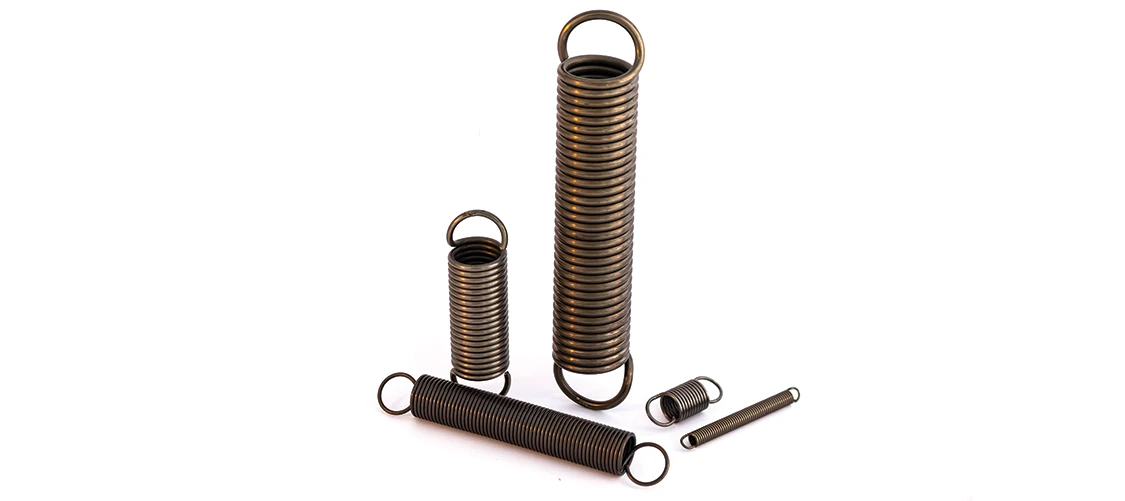
Extension Springs: Reliable Tension, Precise Performance
Extension springs are designed to absorb and store energy when stretched. They are commonly used in applications such as automotive assemblies, machinery, trampolines, and various devices that require tension.
Key Dimensions and Definitions
Understanding the dimensions of an extension spring is essential for proper design and ensuring supply matches the sample. Key measurements include:
- Wire Diameter (d): The thickness of the spring wire. Thicker wire increases strength and tension.
- Outer Diameter (OD) / Inner Diameter (ID): OD is the total diameter across the spring. ID is the distance between the inner edges. These determine the space the spring fits into.
- Body Length: The length of the coiled body of the spring, excluding any hooks or eyes.
- Free Length: The length of the spring when no tension is applied.
- Overall Length: The total length including hooks or end configurations.
- Spring Rate (k): The force required to extend the spring by a unit distance, typically N/mm or lb/in.
- Load P: The load applied at the free length to ensure the spring matches sample performance.

Figure 1: Key dimensions of an extension spring
End Configurations
Extension springs rely on end configurations to attach to components. The most common types include:
English Eyes (Crossover Eyes)
These are traditional crossover hooks where the ends overlap, creating a secure attachment point that distributes load evenly, however it is the weakest eye configuration
German Eyes (Bent ~45°)
The ends are bent approximately 45 degrees, providing flexibility for attachment while maintaining spring integrity. These are used in heavy duty applications.
Machine Eyes (~90° D-Eye)
Resembling a "D" shape with the base bent close to 90 degrees, these ends are often used for heavy-duty applications and precise load alignment, but usually have a smaller inside diameter for the eye.
Choosing the correct end configuration ensures proper installation and reliable tension performance.
Doubling Springs: Series vs Parallel
Multiple extension springs can be combined to achieve desired performance. Springs can be arranged in series or in parallel, which affects their overall length and load capacity differently.
Springs in Series
When springs are connected end-to-end (in series), the total length increases and the combined spring becomes softer, meaning it requires less force to extend. Each spring supports the same load, but the deflection is cumulative:
- Total Length: Sum of individual spring lengths.
- Load Capacity: Same as a single spring.
- Spring Rate (k): The overall spring rate decreases. Calculated as: Total rate(k) = 1 / k1 + 1 / k2 + ...
Springs in Parallel
When springs are assembled side-by-side (in parallel), the total length remains the same but the combined spring becomes stiffer, meaning it can support more load without stretching as much. Each spring shares the load equally:
- Total Length: Same as an individual spring.
- Load Capacity: Sum of all springs’ loads.
- Spring Rate (k): The overall spring rate increases. Calculated as: Assembly rate(k) = k1 + k2 + ...
Understanding the difference between series and parallel arrangements is crucial for designing systems that require precise spring tension, whether you need more deflection or higher load capacity.
Real-World Applications
Extension springs are widely used in garage doors, automotive assemblies, industrial machinery, and consumer products. Correct dimensions, end configurations, and doubling arrangements ensure performance matches the sample.
Design Considerations
When designing or selecting an extension spring, consider load requirements, material type, space limitations, end configuration, and whether springs are used in series or parallel. Small changes can significantly affect performance.
Why Choose Our Springs?
We manufacture precision extension springs to match sample specifications exactly. Our springs are tested for quality and consistency, from light-duty to heavy-duty applications.
Request Your Custom Extension Spring
Our experts are ready to help you choose the perfect spring for your project.